The “Black Box” & Beyond: The Digital Evidence You Need to Win Your Trucking Case
In the moments following a catastrophic collision with an 18-wheeler, the world feels like it’s spinning out of control. Your focus is on your family, your health, and wondering how life will ever get back to normal. But while you are focused on healing, the trucking company’s defense team is already at work. They aren’t just checking on their driver; they are looking at data.
In modern trucking litigation, the most powerful witness isn’t always a person—it’s the digital footprint left behind by the truck itself. To win these cases, we have to look inside the “Black Box” and far beyond it. At Treviño Law, we leverage our deep understanding of defense-side tactics to identify, secure, and deconstruct this digital evidence before it can be buried or deleted.
The Digital Triple Threat: ELD, EDR, and the Qualification File
To hold a trucking company accountable, we need more than just photos of the scene. We need the data that tells us why the crash happened. There are three pillars of evidence that I go after immediately:
1. The Electronic Logging Device (ELD)
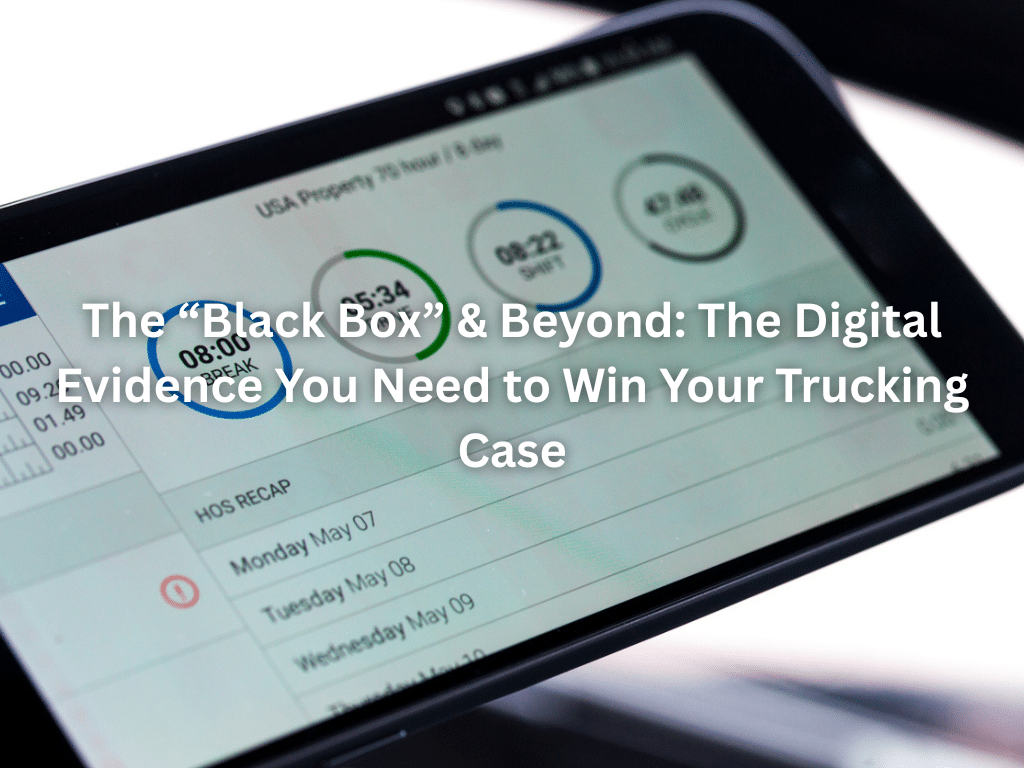
Gone are the days of the “comic books”—those old paper logs where drivers could easily fudge their hours. Modern trucks are equipped with ELDs that automatically record driving time. This device is our primary tool for proving Hours of Service (HOS) violations. If a driver was behind the wheel for 14 hours straight, the ELD is the “smoking gun” that proves they were likely fatigued, making them a ticking time bomb on the highway. According to the FMCSA’s ELD Fact Sheet, these devices are now mandatory for the vast majority of commercial motor vehicles to ensure compliance with rest requirements.
2. The Event Data Recorder (EDR) – The “Black Box”
The EDR is the truck’s version of an airplane’s flight recorder. It captures technical snapshots in the seconds leading up to a crash. It tells us the truck’s speed, whether the driver hit the brakes (or didn’t), the engine RPMs, and even steering angles.
3. The Driver Qualification (DQ) File
This is a “human” data set. Federal law requires trucking companies to keep a file on every driver that includes their driving history, medical certifications, and drug test results. Often, we find that a company put a driver on the road who had a history of reckless driving or a medical condition that should have kept them off the asphalt.
The Race Against the Clock: The 14-Day Window
Here is the part the insurance companies don’t want you to know: Data doesn’t last forever. Many Electronic Logging Devices and onboard camera systems are programmed to overwrite data in a very short window. While the FMCSA requires carriers to retain ELD data for six months, other critical data—like dashcam footage or specific sensor triggers—can be lost in as little as 14 to 30 days as the system recycles memory.
If we don’t act fast, the very evidence that proves the trucking company was negligent can vanish into thin air, legally and permanently. This is why the Spoliation Letter is the most important document in the early stages of a case. This is a formal legal notice we send to the trucking company and their insurer, demanding they preserve all evidence related to the crash. If they delete data after receiving this letter, we can ask the judge for a “spoliation instruction,” which tells the jury they can assume the deleted evidence would have been harmful to the trucking company’s case.
Essential Evidence Checklist
To build a winning case against a commercial trucking entity, I work to get the following evidence must be secured and analyzed:
- ECM/EDR Data: The “Black Box” download showing speed, braking, and throttle position.
- ELD Records: Digital logs for the 6 months leading up to the crash to establish patterns of fatigue.
- Driver Qualification (DQ) File: Training records, annual reviews, and CDL status as outlined by 49 CFR § 391.51.
- Post-Crash Drug and Alcohol Test Results: Mandatory federal testing results following serious accidents.
- Onboard Video Footage: Dashcam clips from both cab-facing and road-facing cameras.
- Maintenance Records: Documentation of brake inspections and mechanical upkeep.
- GPS and Telematics Data: Mapping the truck’s route and identifying “hard braking” events prior to impact.
Jaime’s Perspective
I spent over a decade defending insurance companies before I started Trevino Law. I’ve been in those boardrooms where the “playbook” was written. I know exactly how they try to hide behind technicalities or wait out the clock until data is overwritten.
When I look at a “Black Box” report, I don’t just see numbers. I see a story. I see the moment a driver chose to speed through a yellow light or the moment a company decided that a delivery deadline was more important than the safety of the families driving next to them.
My transition from defense to plaintiff advocacy wasn’t just a career move; it was a realization that the “little guy” needs someone who knows the giants’ secrets. In a trucking case, information is power. If we can secure the data early, we can level the playing field.
Secure Your Future with Treviño Law: Austin’s Choice for Truck Accident Advocacy
In the wake of a collision with a heavy commercial truck, the timeline for preserving vital digital evidence is unforgiving. While you prioritize your medical recovery, the trucking company’s insurance carriers are already deploying investigators to minimize their liability. You need an attorney who has seen their tactics from the inside and knows how to counter them before they start.
At Treviño Law, we provide the aggressive, data-driven representation necessary to take on corporate fleets and secure the maximum compensation you deserve. If you or someone you love has been injured, don’t wait for the data to disappear. Reach out to an experienced Austin truck accident attorney who understands the stakes.
Ready to protect your rights? Schedule a Free Case Evaluation with me today.
Authored By
Jaime Treviño

Founder & Partner, Treviño Law
The Expert Edge: Jaime Treviño is a formidable trial attorney with 20+ years of experience. After a decade representing major insurance corporations, he now uses that “insider” knowledge to protect injury victims—anticipating and neutralizing defense tactics before they can impact a claim.
Proven Results: Jaime has a history of securing landmark results, including $6.3 million settlement of an 18-wheeler accident and an $8.5 million settlement in delivery vehicle crash.
Elite Achievement: Jaime is a Lifetime Member of the Multi-Million Dollar Advocates Forum, a prestigious group limited to the top 1% of U.S. trial lawyers who have acted as lead counsel in cases resulting in multi-million dollar settlements or verdicts.
Education & Memberships:
- University of Texas School of Law (J.D.)
- Ranked #3 Best Truck Accident Lawyers in Austin (TrustAnalytica)
- Member of the Texas Trial Lawyers Association