Can a Truck Driver Blame “Blinding Sunglare” for an Accident on I-70?
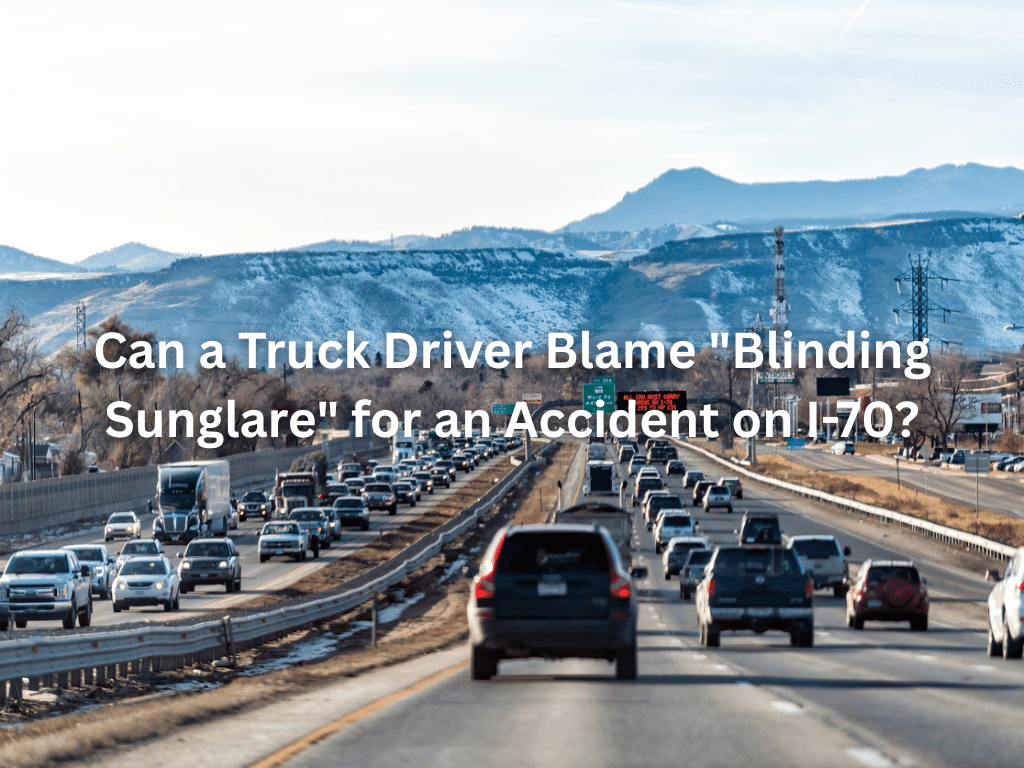
If you have ever driven eastbound on I-70 toward Denver in the early morning, or westbound toward the mountains as the sun dips below the peaks, you’ve experienced it: a sudden, piercing wall of white light that makes the brake lights in front of you vanish.
In Colorado, “blinding sun glare” is one of the most common excuses truck drivers give after a rear-end collision or a lane-drift accident. They often claim the crash was an “unavoidable accident” caused by nature. At Treviño Law, we dig deeper into the regulations to show that sun glare isn’t a legal defense—it is a foreseeable hazard that professional drivers are trained to manage.
The Floyd Hill Factor: Foreseeability on I-70
On the I-70 mountain corridor, sun glare is so predictable that the Colorado Department of Transportation (CDOT) actually implements safety closures at Floyd Hill (Mile Points 244 to 248) between November and February. CDOT and the Colorado State Patrol know that the sun’s angle, combined with the steep terrain, creates a “blind zone” for eastbound drivers every morning.
When a truck accident happens here, a trucking company may claim the sun was an “Act of God.” However, legally, an Act of God must be unforeseeable. Since CDOT posts warnings on electronic signs and the sun rises every day at a mathematically certain time, a professional driver cannot claim they were “surprised” by the light.
Professional Drivers vs. The “Extreme Caution” Standard
The average driver might get a pass for being momentarily dazzled, but commercial truckers driving 18-wheelers are held to a higher standard. Under 49 CFR § 392.14, commercial drivers must exercise extreme caution whenever visibility is obscured.
If the sun is so low that a driver cannot see the lane markings or the vehicle in front of them, the law requires them to:
- Reduce Speed Immediately: They must drive at a speed that is safe for the actual visibility, regardless of the posted limit.
- Increase Following Distance: Professional drivers should double or triple their gap to compensate for reduced reaction time.
- Pull Over Safely: If visibility is zero, the law requires them to exit the roadway until conditions improve. Continuing to drive at highway speeds while “blinded” is a violation of safety standards.
Why the Windshield is “Exhibit A”
Sun glare is often a maintenance issue in disguise. Under FMCSA Regulation 393.60, windshields must be free of damage and discoloration in the driver’s field of vision. We investigate whether the trucking company failed in its duty to maintain the vehicle:
- Pitting and Sandblasting: Years of mountain driving can “pit” a windshield. When low sun hits these tiny craters, the light scatters, creating a “whiteout” effect that wouldn’t happen on a clean, well-maintained windshield.
- Wiper and Fluid Failure: If a driver tries to clear dust during a glare event and their wipers are worn out or they are out of fluid, they can create a smear that permanently blocks their view.
How We Dismantle the “Sun Defense”
Insurance companies often use the “sun glare” narrative because it feels relatable to jurors. Our lead attorney, Jaime Treviño, draws on his decade of experience in insurance defense to anticipate these tactics and shut them down before they gain traction. We focus on the evidence that proves the driver had control over the situation:
- Telematics and Speed Data: We analyze the truck’s “black box” to see if the driver maintained their speed despite the blinding light.
- Pre-Trip Inspections: We subpoena logs to see if the driver properly cleaned the glass or checked their equipment before heading into a sunrise.
- Route Planning: We investigate if the company pressured the driver to continue through a known “sun closure” zone instead of taking a safer break.
Contact Treviño Law for Your Denver I-70 Truck Case
Whether your truck accident happened on the steep grades of I-70 or the wide-open stretches of I-35, don’t let a trucking company use the weather as an excuse for a driver’s failure to act safely.
At Treviño Law, we offer:
- Free, No-Obligation Consultations: We will review your case and explain your recovery options at no cost.
- Contingency Fee Basis: You don’t pay us a dime unless we recover money for you.
- Bilingual Representation: We are proud to serve the diverse Spanish-speaking local communities.
If you were injured by a semi-truck driver who “couldn’t see,” contact Treviño Law today to speak to our Denver truck accident lawyer. We know how to cut through the excuses and fight for the compensation you deserve.