Who Is Liable if a Truck’s Brakes Fail on a Steep I-70 Mountain Grade?
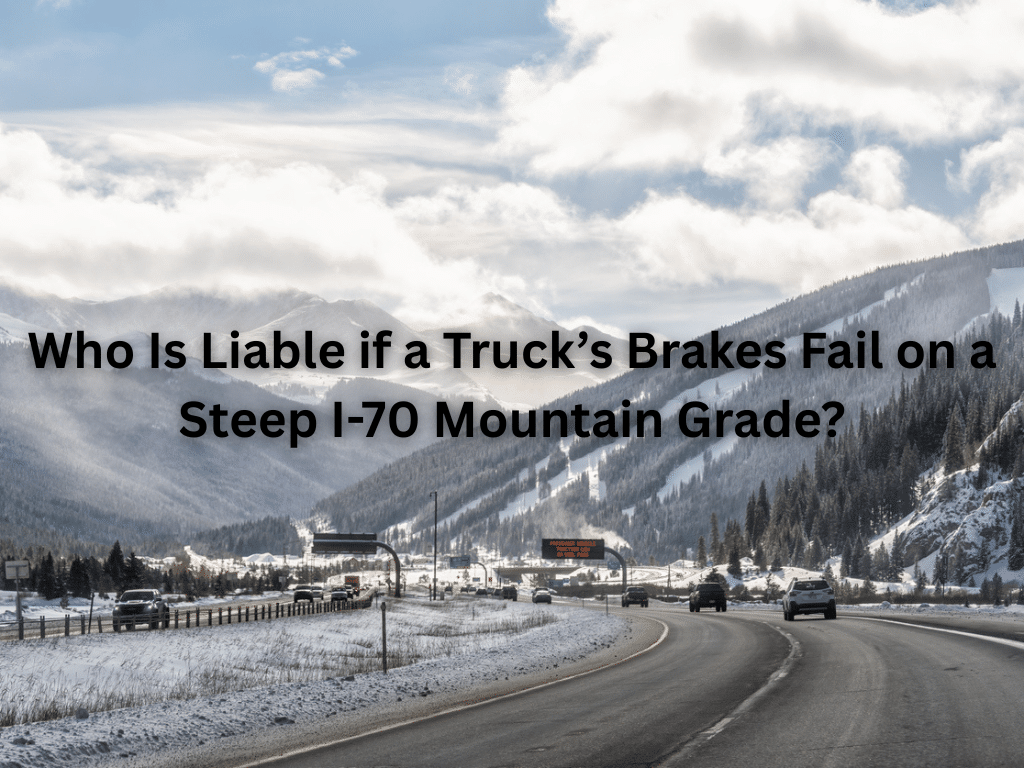 Descending the “Big 70” from the Eisenhower Tunnel toward Silverthorne or down the steep six percent grade of Floyd Hill is a test for any vehicle. For an 80,000-pound semi-truck, it is a high-stakes mechanical feat. When those brakes fail, the results are catastrophic. After a crash, trucking companies often point to “mechanical failure” as if it were an unavoidable stroke of bad luck.At Treviño Law, we know that on a steep grade, brake failure is almost always the result of a chain of human errors. Because we understand the “defense playbook” from the inside, we know that liability rarely stops at the driver; it often reaches into the corporate boardrooms and maintenance bays.
The “Chain of Liability” in Brake Failure Cases
In a typical car accident, you sue the other driver. In a mountain truck crash, there are often several different entities that share the blame:
- The Trucking Company (Motor Carrier): Under 49 CFR § 396.3, carriers have a “non-delegable duty” to systematically inspect and maintain their fleet. If they skipped a mandatory inspection to keep the truck on the road, they are directly liable.
- The Driver: Did the driver bypass the mandatory CDOT Brake Check Stations at the top of the pass? A driver who ignores a “Brake Check” sign and then experiences “brake fade” due to overheating has committed a clear act of negligence.
- The Third-Party Maintenance Shop: Many carriers outsource their repairs. If a mechanic improperly adjusted the slack adjusters or installed substandard brake pads, that shop can be held responsible for the mechanical failure.
- The Loading Company: If the trailer was overloaded or the weight was shifted improperly, the brakes have to work exponentially harder to stop the vehicle. This leads to “glazing”—where the pads become so hot they lose all friction.
Colorado’s “Negligence Per Se” and Brake Checks
Colorado law is particularly strict regarding mountain descents. Under C.R.S. § 42-4-1010, failing to stop at a mandatory brake check station isn’t just a bad idea—it’s a misdemeanor. In a civil lawsuit, this often qualifies as negligence per se.
This means that if we can prove the driver bypassed the station, the court may automatically “presume” the driver was negligent. We don’t have to prove they were a bad driver; the fact that they broke a safety statute designed to prevent this exact type of accident is enough to establish liability.
Why “Brake Fade” Is Not an Excuse
Trucking defense lawyers love the term “brake fade.” They use it to suggest the brakes just “stopped working” because of the heat. However, we know that brake fade is almost always caused by improper driving technique.
Professional drivers are trained in “snub braking” and using the engine brake (jake brake) to maintain speed without riding the service brakes. If a driver “rides the brakes” all the way down Vail Pass until they catch fire, that isn’t a mechanical failure—it’s a failure of professional skill.
How We Investigate Mountain Crashes
At Treviño Law, we don’t just take the trucking company’s word for what happened. We dig into the data that they hope stays hidden:
- The “Black Box” (ECM): We pull the data to see exactly when the driver applied the brakes and for how long.
- Maintenance Logs: We look for “deferred maintenance”—repairs that were noted but delayed to save money.
- Thermal Imaging & Forensic Analysis: We look for evidence of “blueing” on the brake drums, which proves the brakes reached extreme temperatures due to driver error or overload.
Contact Treviño Law for Your I-70 Truck Accident Case
If you’ve been injured by a runaway truck on I-70, you are up against powerful insurance companies that are already building their “mechanical failure” defense.
At Treviño Law, we offer:
- Free Consultations: We will review the accident report and maintenance history at no cost.
- Contingency Fees: You pay nothing unless we win your case.
- Bilingual Representation: We are proud to serve the diverse Spanish-speaking local communities.
Brake failure on a mountain grade is a choice, not an accident. Contact Treviño Law today and let our “insider” experience hold the right people accountable. Speak to our Denver truck accident lawyer today.