How Do Austin’s “Flash Flood” Low-Water Crossings Impact a Trucking Accident Case?
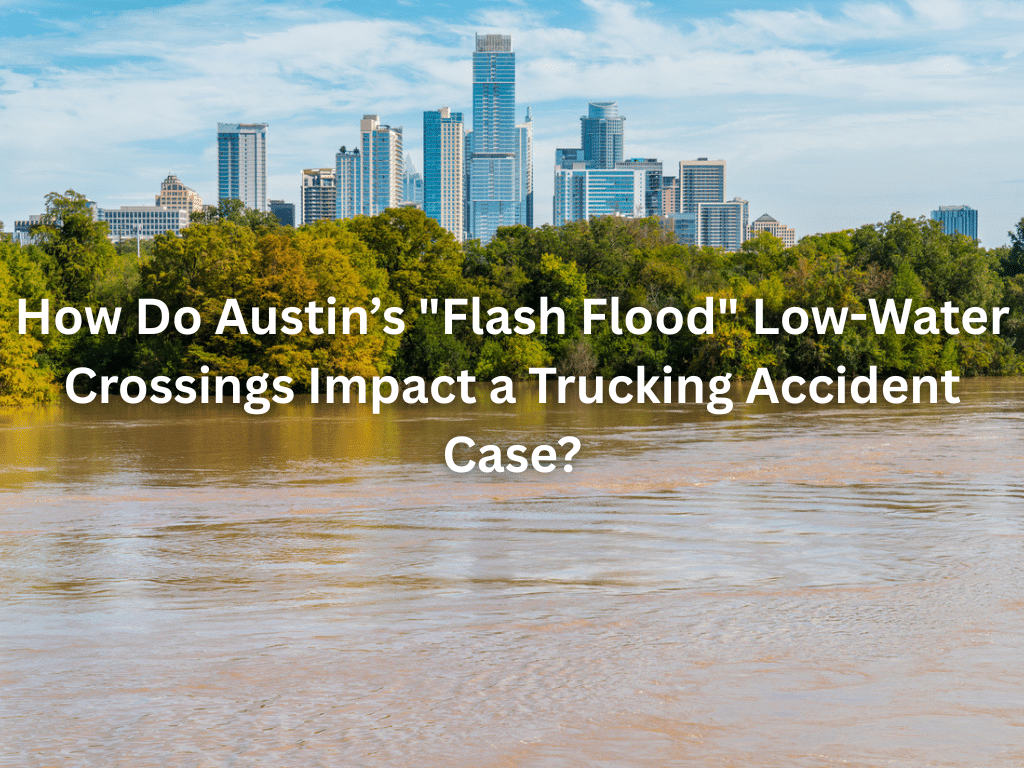
Austin is famously located in “Flash Flood Alley.” During heavy rain events, our city’s low-water crossings—found everywhere from the Hill Country backroads to urban shortcuts—can become death traps in seconds. These geographic features create unique legal challenges when a commercial vehicle is involved in a collision.
When a semi-truck is involved in an accident during or after a flood event, the legal stakes rise instantly. At Treviño Law, we know that trucking companies and their insurers will immediately point to the weather as an “Act of God” to avoid liability. However, because our lead attorney has years of experience in insurance defense, we know how to hold them accountable when “bad luck” was actually a case of bad judgment.
The “Act of God” Defense vs. Driver Responsibility
In Texas, the “Act of God” defense (or Force Majeure) is a legal concept used by defendants to claim that an accident was caused by an unforeseeable natural event that no human could have prevented. While this might work for a lightning strike, a professional truck driver navigating Austin’s weather is held to a higher standard.
Under Federal Motor Carrier Safety Regulation § 392.14, commercial drivers are required to exercise extreme caution when hazardous conditions—such as rain or mist—adversely affect visibility or traction. If the condition becomes sufficiently dangerous, the driver is legally required to stop the vehicle until it can be safely operated. In “Flash Flood Alley,” a heavy downpour is a foreseeable risk, not an unavoidable miracle.
Low-Water Crossings and Negligence
Austin’s ATXFloods system monitors hundreds of low-water crossings in real-time. If a truck driver ignores road closure signs or bypasses a barricade at a low-water crossing, the “Act of God” defense vanishes. In these cases, the driver and the trucking company can be held liable for:
- Negligent Route Planning: Did the dispatch team send the driver through a flood-prone area despite active National Weather Service Flash Flood Warnings?
- Reckless Operation: Attempting to drive a 40-ton vehicle through moving water can cause a truck to hydroplane, jackknife, or lose braking power, endangering everyone on the road.
- Failure to Inspect Equipment: Heavy rain often exposes underlying maintenance issues, such as worn tire treads or faulty windshield wipers, which are required safety standards under the Texas Transportation Code.
The “Sudden Emergency” Doctrine
The defense may also attempt to use the “Sudden Emergency” doctrine, claiming the driver was faced with an unexpected situation (like a wall of water or a sudden road washout) and acted as a reasonably prudent person would.
At Treviño Law, we counter this by looking at the Telematics and GPS data. Most modern trucks are equipped with systems that provide real-time weather alerts to the cabin. If the driver had 10 miles of warning and chose to keep driving toward a flooded crossing, there was no “sudden” emergency—there was a series of negligent choices that ignored clear warnings.
The “Insider” Advantage: Why Jaime Treviño’s Background Matters in Flood Cases
When a truck accident happens during a central Texas storm, the insurance company doesn’t wait for a police report. They immediately deploy a “Rapid Response Team“—a group of specialized adjusters and investigators—to the scene. They want to create a record that the environment, not the driver, was the culprit.
This is where Treviño Law offers an advantage other firms simply cannot match. Our lead attorney, Jaime Treviño, spent over a decade as an insurance defense lawyer. He was the one advising multi-billion dollar carriers on how to devalue claims and shift blame onto “Acts of God.”
Because Jaime has sat on the other side of that table, he knows the internal “playbook” they use to avoid payouts in flood cases. We don’t just wait for the defense to present their version of the storm; we dismantle their arguments using the very tactics Jaime once saw from the inside:
- Exposing the “Delivery at All Costs” Culture: Insurance companies will claim the driver was a “victim of the weather.” We dig into corporate records to see if the trucking company offered bonuses for on-time delivery that effectively pressured the driver to risk a low-water crossing rather than pulling over.
- Advanced Telematics & ELD Analysis: We don’t just look at where the truck was; we look at the Electronic Logging Device (ELD) data to see if the driver accelerated into the storm to “beat the clock,” a clear violation of the “extreme caution” standard.
- Precision Meteorological Forensics: While an insurance adjuster might show a photo of a flooded road an hour after the crash, we work with forensic meteorologists to pinpoint the exact visibility and water depth at the precise minute of the collision.
- Corporate Culture: We investigate whether the trucking company’s “on-time delivery” bonuses pressured the driver to take a dangerous route through a low-water crossing rather than waiting out the storm.
Contact Treviño Law Law for Your Austin Truck Accident Case
If you’ve been injured in a truck accident involving a flash flood or a low-water crossing, don’t let the insurance company blame the clouds for their driver’s mistakes. Austin’s weather is predictable enough that professional drivers have a duty to be prepared.
At Treviño Law, we offer:
- Free, No-Obligation Consultations: We will review your case and explain your options at no cost.
- Contingency Fee Basis: You don’t pay us a dime unless we recover money for you.
- Bilingual Representation: We are proud to serve the diverse Spanish-speaking communities of Austin and Central Texas.
Don’t wait for evidence to disappear. Contact us today to speak to our Austin truck accident lawyer and start your path to recovery. Let us put our insurance defense experience to work for you.