How Does the “Colorado Chain Law” Affect My Truck Accident Claim?
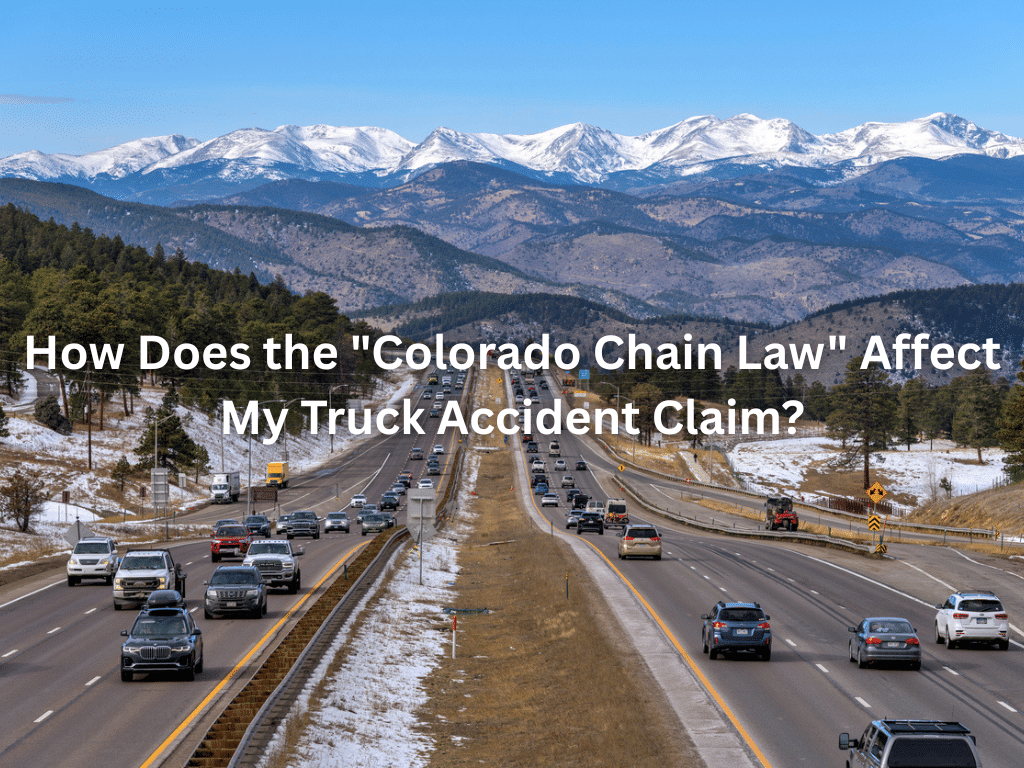
Navigating the Rocky Mountains of Colorado comes with it’s challenges. I’ve seen firsthand how the steep grades of I-70 and the unpredictable weather of the Front Range can turn a standard delivery into a catastrophic disaster. When a massive 18-wheeler loses traction on a slushy incline and plows into a line of passenger vehicles, the legal fallout is as complex as the terrain itself. Specifically, we have to talk about the Colorado Chain Law.
If you were injured in a wreck involving a commercial truck during a Colorado snowstorm, the trucking company’s defense team will almost certainly point to “uncontrollable weather” or an “act of God” to escape liability. I’m here to tell you that in the eyes of Colorado law, that defense rarely holds water. At Treviño Law, I leverage my deep background in insurance defense to prove that what the company calls an “unfortunate accident” was actually a willful violation of safety statutes designed to keep our mountain passes from becoming graveyards.
What is the Colorado Chain Law?
Colorado’s mountain corridors are vital to the American economy, but for a semi-truck, they are a series of high-risk obstacles. To manage this, the Colorado Department of Transportation (CDOT) enforces strict traction requirements. Under Code 17 and Code 18, commercial vehicles are required to carry and—when notified by roadside signage—install chains or alternative traction devices (ATDs) to navigate icy inclines safely.
Specifically, between September 1st and May 31st, all commercial vehicles traveling on I-70 between Mile Point 133 (Dotsero) and Mile Point 259 (Morrison) must carry sufficient chains. If the “Chain Law” is in effect and a driver hasn’t “chained up,” they aren’t just being reckless; they are breaking the law. When I investigate these claims from my Denver office, the first thing I look for is the timestamp of the CDOT alerts versus the truck’s electronic data logs.
How This Law Impacts Your Claim
In a standard car accident, “negligence” can sometimes be a gray area. But when a safety law is specifically violated in Colorado, we move into the territory of Negligence Per Se. This means that because the driver violated a statute specifically designed to protect the public, the legal burden of proof shifts heavily in our favor.
1. Defeating the “Sudden Emergency” Defense
Trucking defense lawyers love the “Sudden Emergency” doctrine. They argue that a sudden patch of black ice was an unforeseeable event. However, if the Colorado Chain Law was active, that ice wasn’t just foreseeable—it was expected. If I can show the driver ignored the flashing signs at the chain-up stations near Silverthorne or Vail Pass, their “emergency” defense evaporates. The Colorado General Assembly has made it clear that commercial operators bear a heightened responsibility for safety on these routes.
2. Proving Improper Equipment and Training
Sometimes the driver wants to chain up, but the company didn’t provide them with the right gear, or the chains were so poorly maintained they snapped under the weight of the load. I dig into the maintenance records to see if the company cut corners. Federal safety standards under the FMCSRs require equipment to be in safe operating condition, and the Colorado Chain Law adds a specific layer of accountability to that requirement for mountain transit.
Essential Evidence in a Colorado Chain Law Case
To win a winter weather truck wreck case in Colorado, I have to be more aggressive than the defense. I focus on securing these specific pieces of data immediately:
- CDOT Variable Message Sign (VMS) Logs: I subpoena these to prove exactly what the highway signs told the driver and the exact minute they were activated.
- Dashcam Footage: This is a powerful visual that shows if other trucks around the defendant were successfully using chains while they were not.
- Onboard Telematics: Modern trucks record “wheel slip” events. If the truck was slipping for miles before the crash and the driver didn’t pull over to chain up, that is evidence of gross negligence.
- Post-Crash Inspection Reports: I want to know if the chains were found in the cab, still in their original bags, or if they were missing from the vehicle entirely.
How does the Colorado Chain Law affect a truck accident lawsuit?
- Establishes Fault: Violating the chain law is often considered “negligence per se,” significantly streamlining the process of proving liability.
- Negates Weather Defenses: It prevents the insurance company from claiming the snow or ice was an “unforeseeable” act of nature.
- Increases Damages: Evidence of willfully ignoring CDOT safety signs can strengthen a claim for higher settlements or punitive damages.
- Broadens Corporate Liability: It allows me to hold the motor carrier accountable for failing to properly train the driver for Colorado’s specific winter terrain.
Jaime’s Perspective
I’ve sat in those defense rooms for over a decade, and I know exactly how they talk about winter wrecks. They’ll look at a pileup on I-70 and try to blame the “elements” or the “road design.” It’s a classic tactic to save the insurance company money. But here’s the truth: weather is a condition, not a cause. The cause of the wreck is a human being—or a corporation—deciding that a delivery deadline is worth more than the safety of the families driving next to them.
In our Denver office, we see the aftermath of these decisions every winter. When a driver blows past a chain-up station because they are running thirty minutes late, it takes me back to my days on the defense side. I know their playbook, and I know how to dismantle their excuses. If Colorado told that driver to chain up and they chose not to, I’m going to make sure they are held accountable for every bit of damage they caused. In the Rockies, there’s no room for error, and there’s no room for excuses.
Secure Your Future with Treviño Law: Denver’s Choice for Truck Accident Advocacy
Whether your accident happened on the crowded streets of Denver or the snowy peaks of the Divide, the strategy remains the same: move fast, secure the data, and out-maneuver the defense. The trucking company is already building their case to blame the storm. You need a Denver truck accident lawyer who has seen their strategies from the inside.
I deliver the strategic, aggressive representation required to challenge corporate giants and obtain the financial justice you are owed. If you or a loved one has been harmed in a commercial crash in Colorado, reach out to me and my Denver team today.
Ready to protect your rights? Schedule a Free Case Evaluation with me today.
Authored By
Jaime Treviño

Founder & Partner, Treviño Law
The Expert Edge: Jaime Treviño is a formidable trial attorney with 20+ years of experience. After a decade representing major insurance corporations, he now uses that “insider” knowledge to protect injury victims—anticipating and neutralizing defense tactics before they can impact a claim.
Proven Results: Jaime has a history of securing landmark results, including $6.3 million settlement of an 18-wheeler accident and an $8.5 million settlement in delivery vehicle crash.
Elite Achievement: Jaime is a Lifetime Member of the Multi-Million Dollar Advocates Forum, a prestigious group limited to the top 1% of U.S. trial lawyers who have acted as lead counsel in cases resulting in multi-million dollar settlements or verdicts.
Education & Memberships:
- University of Texas School of Law (J.D.)
- Ranked #3 Best Truck Accident Lawyers in Austin (TrustAnalytica)
- Member of the Texas Trial Lawyers Association