Why is “The Mousetrap” (I-25 & I-70 Interchange) So Dangerous for Denver Trucks?
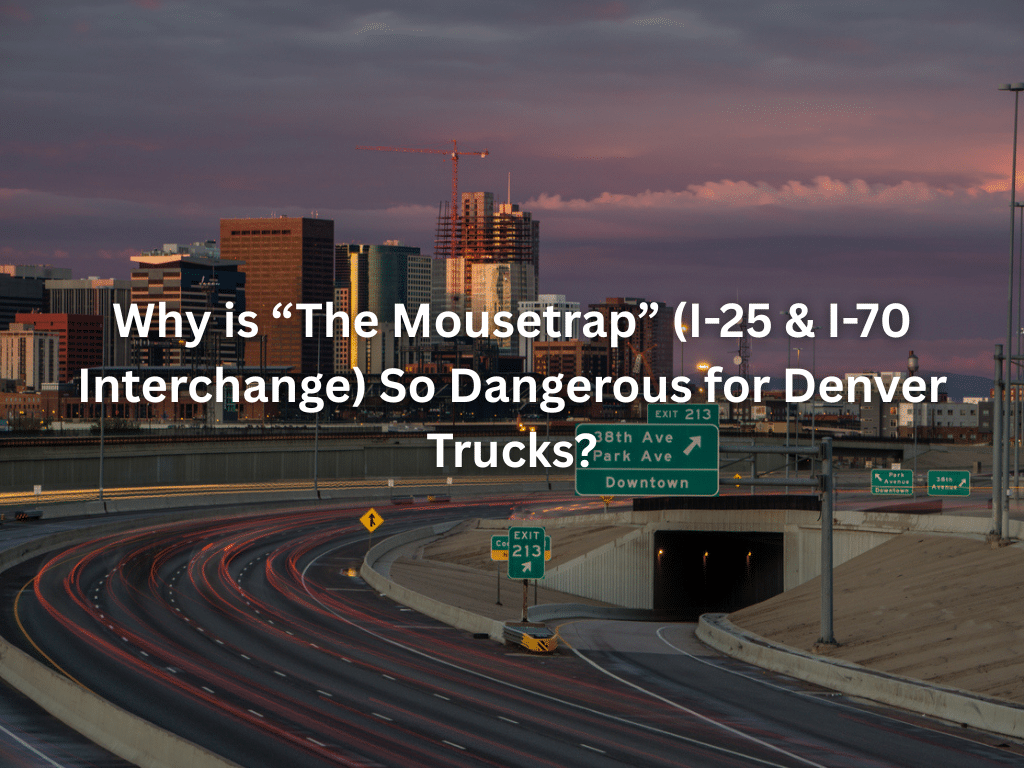
If you’ve lived in Denver for more than five minutes, you know the name. It’s the stuff of local legend and rush-hour nightmares. We call it “The Mousetrap.” Located at the intersection of I-25 and I-70, this massive interchange is the heart of Denver’s transportation network. But as a lawyer who has spent a career dissecting truck accidents from the inside out, I see it differently. I don’t just see a busy bridge; I see a structural hazard that has been “trapping” commercial drivers and passenger vehicles for decades.
Whether I’m working from my office in Denver or coordinating with my team in Austin, I’ve noticed a pattern: catastrophic truck wrecks at the Mousetrap aren’t usually just “bad luck.” They are the result of high-speed corporate pressure meeting a complex, unforgiving piece of infrastructure. At Treviño Law, I use my experience as a former insurance defense attorney to deconstruct these crashes and prove that the design of the road is no excuse for corporate negligence.
A History of “Trapping” Vehicles
The nickname wasn’t born in a marketing room; it was coined by an airborne traffic reporter back in the 1960s who described the maze of super-curvy ramps as a trap for mice. But it was the infamous 1984 Torpedo Incident that solidified its reputation.
A Navy truck hauling six Mk 46 torpedoes took one of the Mousetrap’s exit ramps too fast, flipped, and dumped its deadly cargo onto the freeway. For eight hours, Denver held its breath, paralyzed by the fear of an explosion at the city’s most vital junction. That incident actually forced the Colorado Department of Transportation (CDOT) to eventually rebuild the interchange.
Even with the redesigns, the core issue remains: the Mousetrap funnels roughly 300,000 vehicles a day through a series of flyovers and tight transitions that demand 100% focus—something many commercial drivers lack when they are pushing to meet a deadline.
Why Trucks Specifically Struggle at the Mousetrap
As an attorney who used to defend corporate insurance companies, I know the technical reasons why the Mousetrap is a “truck magnet” for collisions. It comes down to three main factors:
1. Decreasing Radius Curves
Many of the flyover ramps at the Mousetrap have what engineers call a “decreasing radius.” This means the curve gets tighter as you go further into it. For a 4,000-pound car, it’s a nuisance. For an 80,000-pound semi-truck, it’s a recipe for a rollover. If a driver enters that ramp at 45 MPH and the curve suddenly tightens, the centrifugal force can pull the trailer over before the driver can even tap the brakes.
2. High-Stress Merging Zones
The Mousetrap is a “weaving” zone. You have drivers trying to exit I-70 East to get on I-25 South, while others are trying to merge from I-25 North onto I-70 West. This creates constant lane-changing. Because of the massive blind spots on a tractor-trailer, these quick “gap-shooting” moves often result in side-swipe accidents that can easily escalate into multi-car pileups.
3. Inexperienced Drivers and “The Maze”
Denver is a major logistics hub. We have thousands of drivers passing through who have never seen the Mousetrap before. When an inexperienced driver sees three different overhead signs and four possible lanes in the span of 500 feet, they panic. Sudden lane changes in an 18-wheeler are never “minor”—they are life-altering.
Essential Evidence Checklist for Mousetrap Collisions
To build a winning case after a crash at the I-25 and I-70 interchange, I secure and analyze the following data immediately:
- Telematics and GPS Data: To determine if the driver was speeding into the known hazards of the interchange ramps.
- Onboard Video Footage: To identify the “startle response” or distractions like mobile device usage during the merge.
- Driver Qualification (DQ) Files: To check if the company properly trained the driver for high-density urban interchanges.
- Maintenance Logs: Specifically looking at brake adjustment and tire tread, which are critical on high-incline flyovers.
- Citywide Safety Data: I cross-reference the crash with Vision Zero Denver statistics to show the systemic danger of the area.
Jaime’s Perspective
I spent over a decade in the boardrooms of insurance companies, and I’ve seen exactly how they handle “Mousetrap” claims. Their first move is almost always to blame the city or the “confusing signs.” They want to pretend their driver was a victim of the road design rather than their own negligence.
I don’t buy it. I’ve driven the Mousetrap hundreds of times. I know that if a driver is properly trained, rested, and following federal safety regulations, the Mousetrap is navigable. Wrecks here happen because a company put an untrained driver in a high-stakes environment or pressured them to speed through a congested zone to make a delivery. My transition to the plaintiff side means I can spot these excuses a mile away and dismantle them before they ever reach a jury.
Secure Your Future with Treviño Law: Denver’s Strategic Truck Accident Advocate
If you or a loved one has been caught in a wreck at the I-25 and I-70 interchange, you are up against a massive legal machine. The trucking company’s “Rapid Response Team” likely had people at the Mousetrap before the police even finished their report. You deserve a Denver truck accident lawyer who knows their strategy before they even deploy it.
I deliver the strategic, high-stakes advocacy required to challenge corporate giants and obtain the financial justice you are owed. Reach out to me at our Denver office today to start building your case.
Ready to discuss your claim? Schedule a Free Case Evaluation with me today.
Authored By
Jaime Treviño

Founder & Partner, Treviño Law
The Expert Edge: Jaime Treviño is a formidable trial attorney with 20+ years of experience. After a decade representing major insurance corporations, he now uses that “insider” knowledge to protect injury victims—anticipating and neutralizing defense tactics before they can impact a claim.
Proven Results: Jaime has a history of securing landmark results, including $6.3 million settlement of an 18-wheeler accident and an $8.5 million settlement in delivery vehicle crash.
Elite Achievement: Jaime is a Lifetime Member of the Multi-Million Dollar Advocates Forum, a prestigious group limited to the top 1% of U.S. trial lawyers who have acted as lead counsel in cases resulting in multi-million dollar settlements or verdicts.
Education & Memberships:
- University of Texas School of Law (J.D.)
- Ranked #3 Best Truck Accident Lawyers in Austin (TrustAnalytica)
- Member of the Texas Trial Lawyers Association