Is a Truck Driver Liable for an Accident on the I-35 “Upper/Lower Deck” Split?
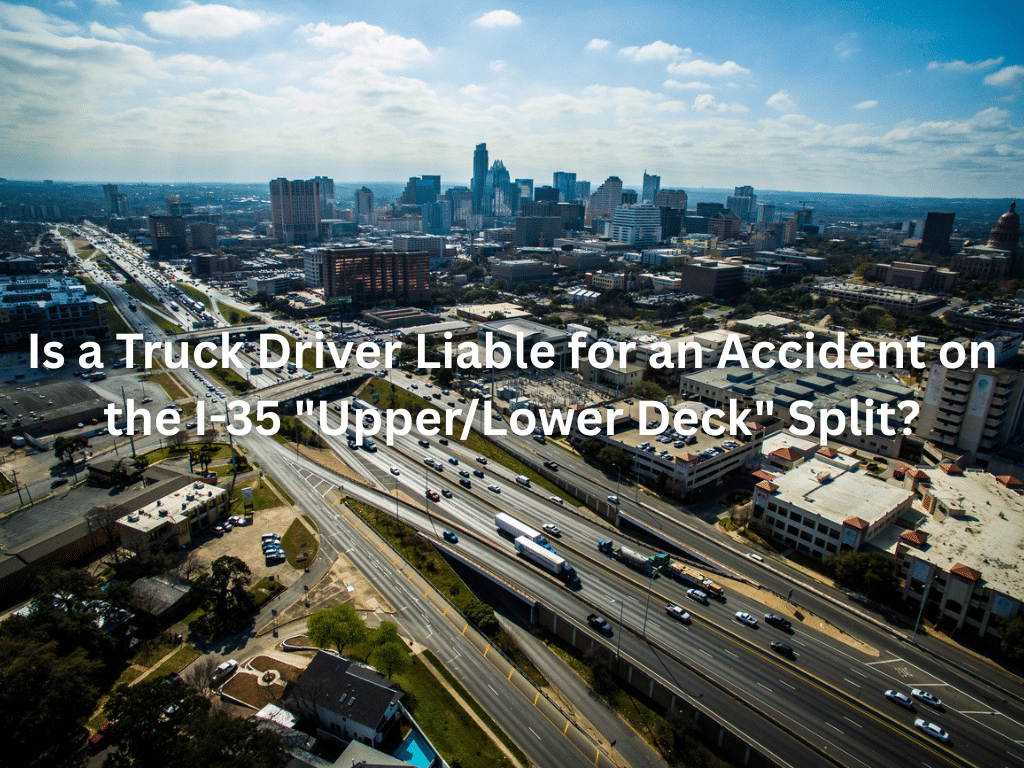
If you’ve lived in Austin for any length of time, you know the feeling of dread as you approach the I-35 “Upper/Lower Deck” split near downtown. It is one of the most stressful stretches of highway in Texas, where drivers are forced to make split-second decisions while being surrounded by massive 18-wheelers. When a collision happens here, the trucking company’s first defense is almost always the same: “The road design is confusing, and the merging traffic was unpredictable.”
I don’t buy that excuse. As a lawyer who has spent a career investigating truck accidents from the inside out—including a decade spent defending the very companies I now sue—I know that the complexity of the I-35 split is no excuse for negligence. At Treviño Law, I hold truck drivers and motor carriers accountable by proving that their failure to plan for this known Austin hazard is exactly what led to your accident.
The Anatomy of the Split: Why Liability is Contested
The I-35 decks, built in the early 1970s, were never designed to handle the 200,000+ vehicles that traverse them daily. The split between 15th Street and Airport Boulevard creates a “weaving” effect where passenger cars are trying to get to the lower deck for local exits while long-haul trucks are trying to stay on the upper deck to bypass city traffic.
When a wreck occurs at the split, the question of liability usually centers on Failure to Maintain Lane and Unsafe Lane Changes. The Texas Department of Transportation (TxDOT) data consistently ranks this corridor as one of the most crash-prone in the state. Because the lanes are narrow and the margins for error are razor-thin, a truck driver who isn’t 100% focused can cause a multi-car pileup in a heartbeat.
Determining Liability: Was it the Driver or the Road?
Trucking companies will point to the narrow 11-foot lanes and the lack of shoulders on the upper deck as “contributing factors.” While the road design is certainly flawed, federal law is very clear: commercial drivers must adjust their driving to meet the conditions of the road. To prove the driver is liable, I focus on several key areas:
1. Speeding Through the Split
The speed limit on the I-35 decks is often lower than the surrounding highway, but many truckers try to maintain their momentum to stay on schedule. If a driver is doing 65 MPH in a zone that requires 55 MPH due to narrow lanes, they have effectively forfeited their ability to react to a merging car. I use “Black Box” (EDR) forensics to prove exactly how fast that truck was moving at the moment of impact.
2. Improper Use of Blind Spots
On the lower deck, the concrete pillars and frequent merges create massive visibility issues. A truck driver has a legal duty to be aware of their “No-Zones.” If a trucker moves into your lane at the split because they “didn’t see you,” that isn’t a freak accident—it’s a failure to follow the [FMCSA’s safety guidelines regarding blind spots](https://www.fmcsa.dot.gov/ourroads/tips-driving-safely-around-large-trucks-or-buses).
3. Driver Fatigue and Local Knowledge
Many of the drivers causing wrecks on I-35 are long-haulers coming from Laredo or out of state. If they are fatigued, their ability to navigate a complex split like Austin’s is severely compromised. I dig into the Electronic Logging Device (ELD) data to see if the driver was over their hours, making them more likely to panic or make a mistake at the 15th Street transition.
Future Changes: The I-35 Capital Express Project
Even TxDOT admits that the current configuration is inadequate for modern safety needs. Under the massive I-35 Capital Express Central project, the notorious upper decks will eventually be torn down entirely. The multi-billion dollar redesign aims to remove the “split” by lowering the main lanes through downtown Austin. While this project promises a safer future, the construction phases will likely create even more narrow lanes and confusing detours for the next decade—making it more important than ever for truckers to exercise extreme caution in the heart of our city.
The Evidence Needed to Win an I-35 Deck Case
Because the trucking company will try to blame the “confusing” Austin traffic, we have to be surgical with our evidence. To win, I secure:
- TxDOT Traffic Camera Footage: These decks are heavily monitored. We move quickly to subpoena video before it is overwritten.
- ELD and GPS Data: To show the driver’s speed and “hard braking” events leading up to the split.
- The Driver’s Route Plan: Did the company give the driver enough time to safely navigate Austin traffic, or were they pressured to speed?
- Post-Crash Inspection: On the upper deck’s steep inclines, brake performance is everything. We check if the truck’s equipment met the standards set by the Commercial Vehicle Safety Alliance (CVSA).
Is a truck driver at fault for an accident at the Austin I-35 split?
- Yes: If the driver failed to maintain their lane or was traveling too fast for the narrow deck conditions.
- Yes: If the driver was fatigued or distracted while navigating the complex weaving zones near downtown.
- Yes: If the motor carrier failed to train the driver on navigating high-density urban corridors.
- Evidence: Proving fault requires digital forensics from the truck’s “Black Box” and local traffic camera footage.
Jaime’s Perspective
I’ve lived in Austin for a long time, and I’ve driven the I-35 decks more times than I can count. I know exactly where the lane disappears at the split and where the trucks tend to drift. When I worked on the defense side, we used the “Upper Deck” as a shield. We’d tell juries, “It’s a terrible road, how can you blame a driver for being confused?”
But here’s the reality: Professional drivers are trained specifically to handle “terrible roads.” If a driver is too confused to handle the I-35 split, they shouldn’t be behind the wheel of an 80,000-pound vehicle in our city center. When I take these cases, I enjoy dismantling the “confused driver” defense. I show that the driver knew the split was coming, had the tools to navigate it safely, and chose to prioritize their schedule over your safety. In Austin, we don’t accept excuses for recklessness on our highways.
Secure Your Future with Treviño Law: Austin’s Strategic Truck Accident Advocate
If you’ve been injured on the I-35 Upper or Lower Deck, you are facing a trucking company that is already preparing to blame the road, the city, or even you. You need an Austin truck accident lawyer who has seen their playbook and knows how to push back with hard data and aggressive litigation.
I deliver the high-stakes advocacy required to challenge these corporate giants and win. Don’t let the insurance company tell you that your accident was “unavoidable.” Reach out to me and my Austin team today.
Ready to discuss your claim? Schedule a Free Case Evaluation with me today.
Authored By
Jaime Treviño

Founder & Partner, Treviño Law
The Expert Edge: Jaime Treviño is a formidable trial attorney with 20+ years of experience. After a decade representing major insurance corporations, he now uses that “insider” knowledge to protect injury victims—anticipating and neutralizing defense tactics before they can impact a claim.
Proven Results: Jaime has a history of securing landmark results, including $6.3 million settlement of an 18-wheeler accident and an $8.5 million settlement in delivery vehicle crash.
Elite Achievement: Jaime is a Lifetime Member of the Multi-Million Dollar Advocates Forum, a prestigious group limited to the top 1% of U.S. trial lawyers who have acted as lead counsel in cases resulting in multi-million dollar settlements or verdicts.
Education & Memberships:
- University of Texas School of Law (J.D.)
- Ranked #3 Best Truck Accident Lawyers in Austin (TrustAnalytica)
- Member of the Texas Trial Lawyers Association